
Humans were first hermaphrodites and God divided each person into two halves. These halves have been wandering around the world looking for each other ever since.
A myth from Plato’s “Feast”

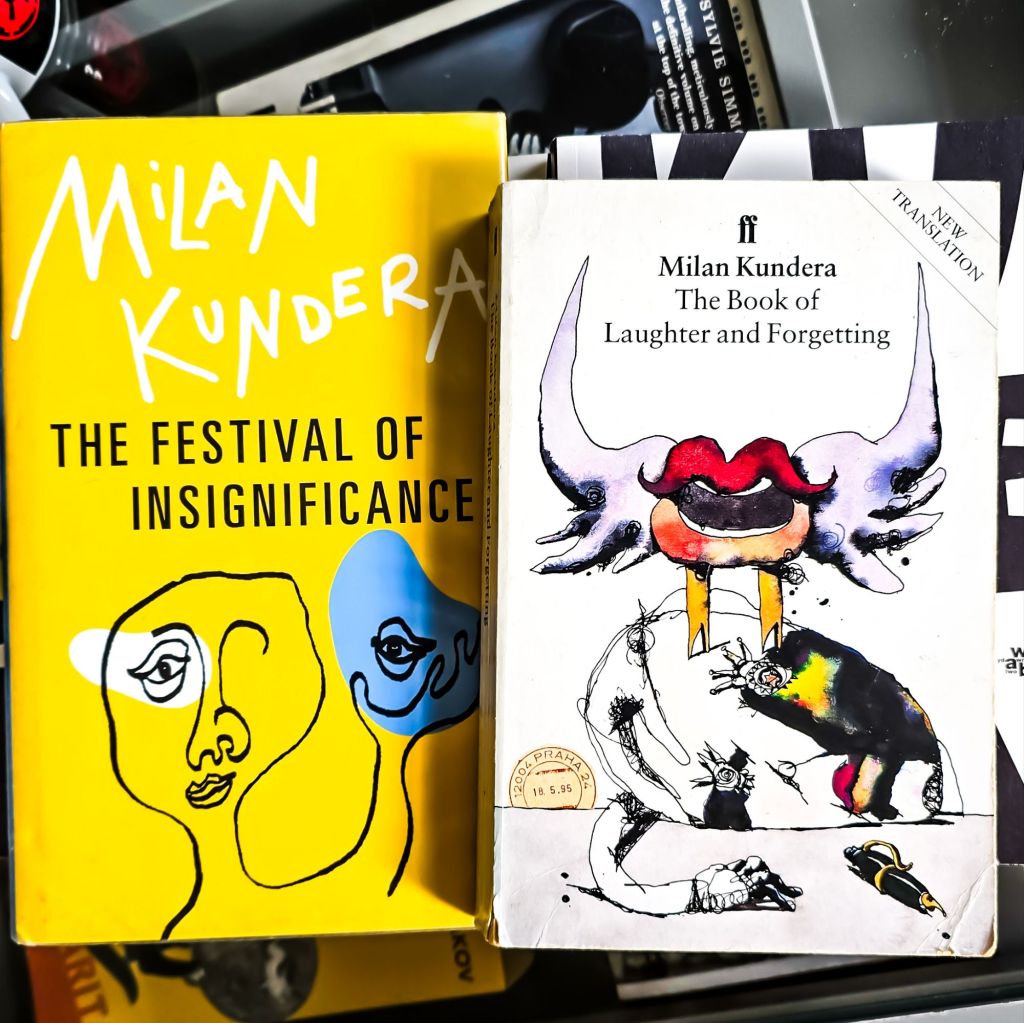
Milan Kundera’s book appeared on my bookshelf some time ago, but I only decided to reach for it recently. I am thrilled with it, and utterly blown away by it.
His work is filled with philosophical contemplation that creates a vivid image of a human being struggling with contradictions and kitsch (yes, my dear readers, that kitsch that surrounds us these days). It also shows the crusade in the individual’s struggle against authority and the conflict between memory and forgetting.
“The Unbearable Lightness of Being”, is his most recognizable novella I started my adventure with (It goes without saying, doesn’t it?). Of course, when, if not on holidays, to sink unreservedly into this book. I finished it in one breath, still looking for reasons I hadn’t done it sooner. Without any doubt, I am enchanted by this book, enthralled, and the image of lightness and heaviness makes me lost in thought, since “es must sein!” (it must be!). Quote from the String Quartet No. 16 in F, Op. 135 Beethoven’s symphony, reminds us that “human life happens only once (…). We are not given any second, third, fourth (…) so that we can compare the consequences of our decisions.”
The novel made it clear, to me, that our decisions are influenced by more than just our inner selves. Social pressure, religious motives, love, and other factors play a role as well. It’s easy to forget that our conscience, which replaces the usual survival instinct, is there to guide us.
The characters, as Kundera himself writes, “are variants of myself that have not been realized (…) therefore I love all of them equally and all of them frighten me equally, each of them crossing some boundary that I have only gone around (…) human life in a trap.”
The characters, as Kundera himself writes, “are variants of myself that have not been realized (…) therefore I love all of them equally and all of them frighten me equally, each of them crossing some boundary that I have only gone around (…) human life in a trap.”, take us deep into their fears and beliefs with great honesty, when love becomes a burden and the fall a liberation. Like Teresa convinced that “dizziness is something other than the fear of falling. Dizziness means (to her) that we are attracted by this depth beneath us, lured by it, aroused by the desire to fall.” The protagonist’s nightmarish dreams themselves, which result from Thomas’s notorious infidelities, show us the immensity of her love for her husband and, despite everything, the two can’t exist without each other.
Life passes irretrievably, as the author points out, and the consequences of our decisions cast a shadow over our future; the burden of being is not always bad and the lightness can become unbearable and semi-real. Sabina (one of Thomas’s lovers), a highly regarded painter, shows us a picture of the hypocrisy of reality, the so-called collective amnesia, when “the canvas of a painted decoration (…) has an understandable lie in the foreground, from behind it shines an incomprehensible truth.”
In my opinion, nonetheless, the book delves into the complexities of love, exploring the intertwining elements of passion and the burdens that come with it, portraying the crushing weight and the hardships. Yet, it is expected and surprising at the same time.
That’s all, for now…
Currently reading: Milan Kundera ‘Immortality’.
Finally, proposals from my TBR list:

Mai Mochizuki


Yours L.

 another pile of books
Leave a comment